
The opportunity wasn't simply to predict risk.
Alzheimer’s risk assessment involves multiple signals that can be difficult to interpret in isolation. The opportunity was to bring these signals together into a clearer decision-support experience
Complex signals
PRODUCT OPPORTUNITY
Fragmented information
Decision uncertainty
01
02
03
Multiple signals can contribute to understanding cognitive decline.
Create a decision-support experience that simplifies complexity without taking the decision away from the clinician.
Relevant information can be difficult to interpret across a clinical workflow.
A prediction alone doesn't provide enough context for a meaningful decision.
01
THE OPPORTUNITY
The challenge isn't a lack of data. It's making sense of it.
Clinicians may have access to multiple patient signals, but turning those signals into a clear understanding of risk can be difficult.
Fragmented information
PRODUCT PROBLEM
Complex interpretation
Decision uncertainty
01
02
03
Patient information can be spread across the workflow.
How might we help clinicians move from complex patient information to clearer, more confident decision-making?
Multiple signals can be difficult to interpret without context.
A prediction doesn't explain what matters or what to do next.
02
THE PROBLEM
Understanding where the product could create value
I explored the workflow, information needs, existing approaches and constraints surrounding early risk identification.
CLINICAL WORKFLOW
EXISTING APPROACHES
KEY DISCOVERY
INFORMATION NEEDS
CONSTRAINTS
01
02
04
03
Where could decision support reduce friction?
How are patient information and risk surfaced today?
The opportunity wasn't simply to predict risk. It was to make the information around that prediction useful.
What context is needed alongside a risk signal?
What should shape trust, interpretation and workflow fit?
03
DISCOVERY
Define the product around the decision — not the technology.
The product should use AI to reduce complexity while keeping clinical judgment at the centre.
CONTEXT BEFORE PREDICTION
PRODUCT GOAL
AI ASSISTS, CLINICIAN DECIDES
STRATEGIC DIRECTION
SIGNAL OVER NOISE
FIT THE WORKFLOW
01
02
04
03
Give clinicians the context needed to interpret risk.
Reduce the friction between patient information and clinical decision-making.
Support interpretation without replacing clinical judgment.
Build a decision-support product, not simply an AI prediction tool.
Surface what matters most for the decision.
Make decision support part of the clinical workflow.
04
PRODUCT STRATEGY
The product decisions that shaped the experience
DECISION SUPPORT, NOT DIAGNOSIS
PATIENT CONTEXT AROUND
THE INSIGHT
ONE CONNECTED WORKFLOW
01
02
03
The dashboard surfaces AI-generated risk insights to support clinical review, rather than presenting the prediction as a diagnosis
The AI result is presented alongside relevant patient information so clinicians can interpret the signal in context
Patient information, AI insights and supporting evidence are brought together in one workflow for clinical review.
08
KEY PRODUCT DECISIONS
What I would validate next.
WORKFLOW FIT
UNDERSTANDING THE AI INSIGHT
TRUST & ACTIONABILITY
01
02
03
Can clinicians understand and move through the workflow without unnecessary friction?
Is the information surrounding the AI result clear and useful for clinical review?
The concept establishes the product direction. The next step would be testing whether the workflow and AI insights are genuinely useful in clinical practice
Does the experience provide enough clarity for clinicians to decide what to do next?
09
VALIDATION & NEXT STEPS
What the project taught me.
01 — START WITH THE DECISION
02 — CONTEXT MATTERS
03 — DESIGN FOR THE WORKFLOW
AI becomes more useful when the product is designed around the decision it needs to support.
Presenting a prediction is only part of the experience; the surrounding information shapes how it can be understood
A strong clinical product should fit naturally into how information is reviewed and decisions are made
The next iteration would focus on clinician feedback, workflow validation and refining the product around real clinical needs.
10
OUTCOME & LEARNINGS
P0 — MVP
Patient overview
Risk assessment
AI-assisted prediction
Supporting indicators
Patient history
Analytics
—
—
—
—
—
Advanced reporting
P1 — NEXT
P2 — FUTURE
Prioritizing the shortest path to product value.
I focused the MVP on the core decision-support loop rather than building a complete clinical platform.
MVP FOCUS
Context → Assessment → Prediction → Insight
Keep the core decision-support loop focused and actionable.
05
PRIORITIZATION
A connected workflow from patient context to decision support.
I defined the product around a simple flow: understand the patient, assess risk, interpret the prediction, and support the next decision.
CORE PRODUCT LOOP
—>
—>
—>
—>
—>
PATIENT LIST
PATIENT PROFILE
RISK ASSESSMENT
AI PREDICTION
SUPPORTING INSIGHTS
CLINICAL DECISION
Context → Assessment → Prediction → Insight → Decision
06
PRODUCT DEFINITION
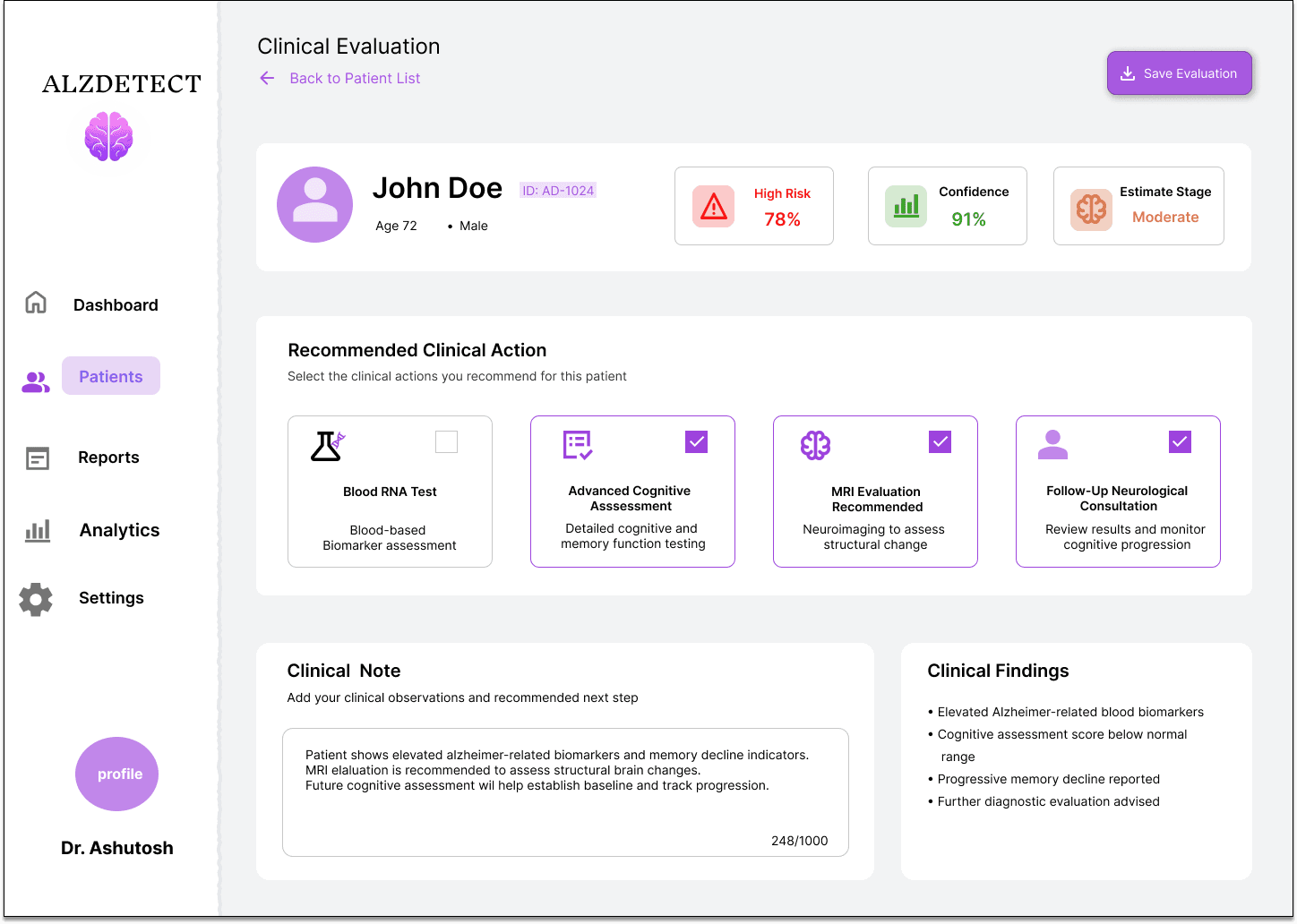
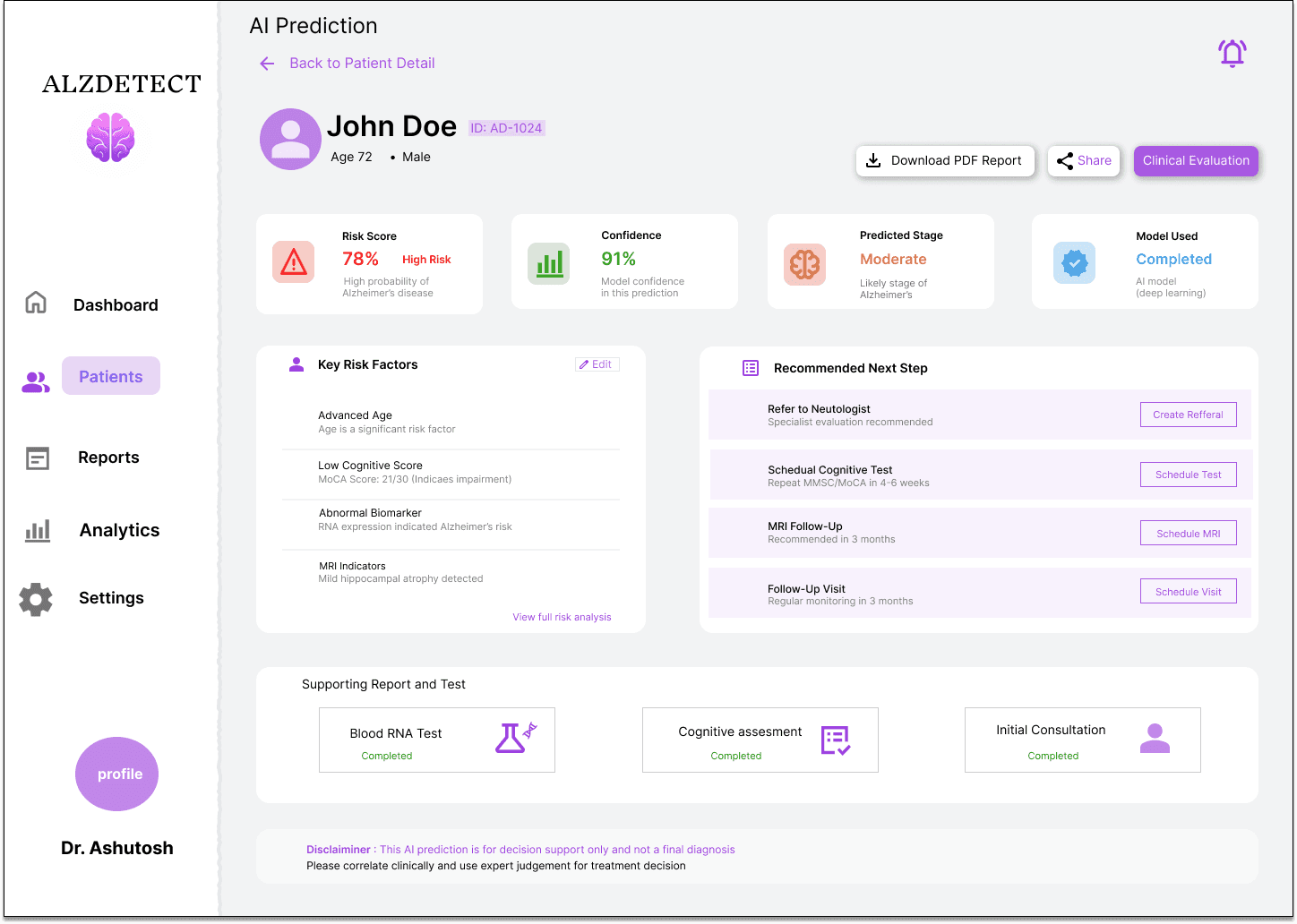


Turning the product strategy into an experience.
A clinician-focused dashboard that brings patient context, assessment and AI-assisted insights into one connected workflow.
07
SOLUTION